
How a Nurse Invented Wild Wipe: “I Just Hate Having Damp Knickers”
Nurse, researcher and inventor Caitlin Dean tells High Flying Design founder and editor Shannon Kate Murray how a cut-up bank card became Wild Wipe, and why the lean start-up model doesn’t work when your product needs manufacturing.
Caitlin Dean had tried every gadget on the market designed to help women wee standing up outdoors. A keen camper and bushcraft enthusiast, she found them fiddly and, as she puts it, frankly unnecessary. She never minded squatting. What she minded was damp knickers afterwards, and the idea of carrying used loo paper out in her rucksack.
She’d also seen what happens when women can’t wipe properly. Caitlin was a registered nurse for nearly 20 years, and once she started nursing, women on hiking and camping trips began coming to her for advice, often sore or with urinary tract infections after a few too many drip-dries.
So she cut up an old bank card in her kitchen, rounded off the edges with sandpaper and made the first Wild Wipe. Then she made one for her daughter, and a spare. It was quite a while before she searched properly to see if anyone had beaten her to it. Nobody had.
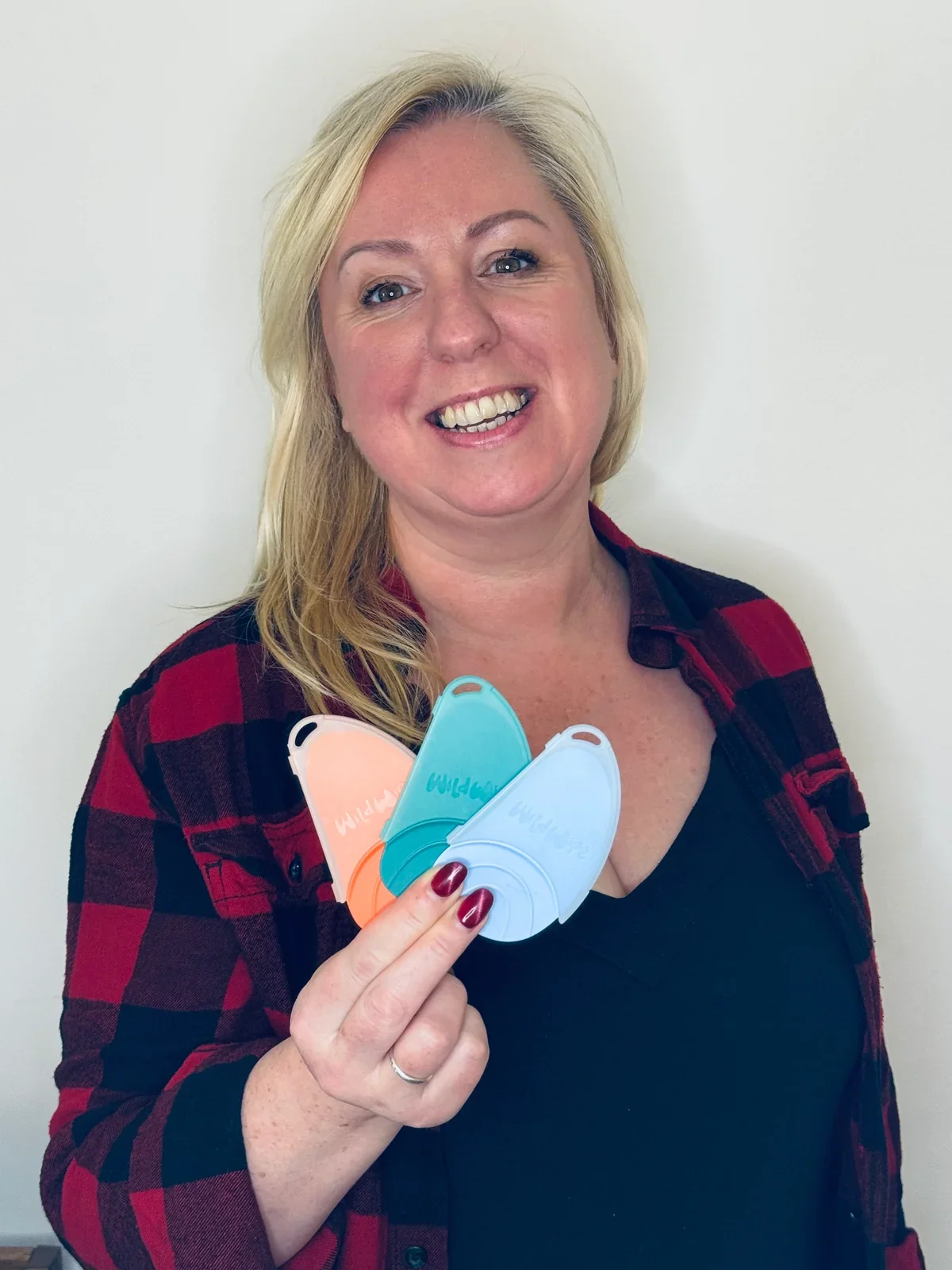
Photo: Caitlin Dean, Founder of Wild Wipe
That homemade version became Wild Wipe, a reusable, pocket-sized wiper for after you wee. It launched in 2026 and is now patent pending. Getting there meant tooling for injection moulding, input from engineers and packaging that Caitlin says was harder than everything else combined. She funded it herself, and the first 4,500 units were packed at her kitchen table by Caitlin, her teenagers and their friends.
She also earned a PhD in medical research and campaigned on hyperemesis gravidarum, but she’s had to learn the business side from scratch. Here she talks us through what it takes to bring a physical invention to market, and why showing women how to use it is harder than it sounds when platforms limit what you can post.
The first Wild Wipe was a cut-up bank card. Where were you when you made it, and how long did you use your homemade version before you thought it could be a business?
CAITLIN: I made my first prototypes in my kitchen with some scissors and sandpaper. It was pretty crude but it did the job so I made a couple more: one for my daughter and a spare. I thought straight away that it could be a business, but I also thought that if I looked online enough I would find it had already been invented. It was quite a while later that I really started to search online for a similar product and realised it really hadn’t been invented yet.
Women came to you for advice on trips because of your nursing background. How much did those conversations shape the product, and did you test early versions with other women before committing to manufacture?
CAITLIN: It didn’t click at first. I just used to be really frustrated by the lack of options for women, and by my own anatomy when it came to weeing. It was after I came up with the first prototypes and discussed it with a few friends that it started to take shape.
We did loads of early prototype testing and made sure to use women who didn’t know me personally too, so they’d give feedback more honestly and openly. Two things were apparent from that: women wanted a case for it, and they needed some instruction to get going. Apart from that, the response was overwhelmingly positive, and early testers reported back months later that they were using it frequently and taking it everywhere with them.
As a nurse and medical researcher, what do you know about the health side of drip-drying that most women don’t?
CAITLIN: Sadly, very little, because there’s a gigantic chasm in the research looking at women’s normal urination and hygiene methods. I think anyone who has had a daughter and potty trained her knows what it’s like when she hasn’t been wiping properly, or has been out drip-drying all day.
There’s research on nappy rash and on the tissue damage caused by urinary incontinence, but almost none on the effects for women who have to drip-dry more often than most, such as hikers, campers and foreign travellers, or women living in poverty, sleeping rough or living in difficult situations.
What did it take to get from a homemade prototype to something you could sell? Talk us through materials, finding a manufacturer, and what changed in the design along the way.
CAITLIN: Wow, that’s a big question, and to be honest I could write a book on the answer… It’s been such a big journey and a massive learning curve at every step: figuring out the perfect design, working out how to actually make it (we injection mould), finding a manufacturer (we’ve already changed from the first guys) and finding the best packaging to suit all retailers’ requirements (this was harder than all the rest combined). It’s been such a vast amount of work and learning.
We’re now trying to get stocked in shops and export to other countries and, my goodness, it’s so complicated. The EU regulations make our heads want to explode.
The product is patent pending. Why did you decide to protect it, what was the process like, and would you recommend it to other product founders?
CAITLIN: Initially I was undecided about patenting it, as it’s quite a copiable product and it’s difficult to pursue claims when it gets copied by big companies. However, when I looked into it a bit more, I realised there were a number of benefits for a completely new product like this that make it worth the effort and expense.
I also think it helps with credibility and visibility, and makes it clear that this is brand new and not a variation on something that’s been around before. Whether or not I’d recommend it would depend very much on what the product is, and whether a patent would give a commercial edge.
What did it take to fund the launch?
CAITLIN: The whole “lean start-up” concept is all very well for tech firms, where you just need you and a decent computer, or for hobbies that turn into businesses. But I really don’t think it’s realistic for a lot of products, and particularly not for brand-new inventions that need manufacturing.
It’s not like I could try selling my homemade prototypes. I had to invest in the tooling for the product to be injection moulded, and that required input from consultants like engineers. Then money had to be spent on raw materials, and the packaging needed to be designed and printed, and so on. That’s not to mention the website costs, regulatory costs, the cost of barcodes and accounting software, which is mandatory now.
I’ve been lucky enough to be able to bootstrap the overheads myself, but it takes a lot of work and dedication to doing whatever we can ourselves, so that money is prioritised for the things we can’t do. The first 4,500 Wild Wipes were packed at my kitchen table by me, my teenagers and their friends, who luckily like my cooking and think it’s cool I’m launching a product. Unfortunately, as teenagers do, they got bored after the first 4,500, so I’m largely doing the next batch of 15,000 on my own, unless I’m willing to pay them properly instead of just feeding them and giving them lifts places.
I also pick and pack all orders myself and built a lot of the website myself. Until recently I was doing the bookkeeping too, but now sales are coming in from multiple streams, it’s a bit above my ability.
Your brand voice is playful (“a gentle squeegee for your vageegee”). How did you decide on that tone for a product most people are embarrassed to discuss?
CAITLIN: I’ve been a fairly brash feminist all my life, and I’ve never shied away from talking about taboo issues. That said, we did need to find a balance and make sure we’re culturally sensitive enough to appeal to women from all walks of life.
I don’t really know if we’ve achieved that yet, and I suspect probably not, as our current demographic is pretty homogeneous. I think as we grow, we’ll adapt our messaging and voice to appeal to women and girls from all sorts of different cultures and countries. It’s very rare that a one-size-fits-all approach works universally.
Have you hit barriers marketing an intimate hygiene product, such as ads being rejected or retailers being squeamish? How have you worked around them?
CAITLIN: We’re struggling with this at the moment. A lot of women have been asking for graphic instructions, but restrictions on social media mean we can’t be too graphic or we risk having our accounts blocked. We’ve tried a number of approaches, like using an inner elbow to look like the top of the legs and demonstrating with water on our arms, but none have been ideal.
Other products such as tampons and Mooncups use cross-sectional, medical-style instruction leaflets, but that won’t work so well for this. To be honest, it’s not a totally alien concept… we all figured out how to insert tampons well enough, and how to use a razor down there.
How did you arrive at £13.99 as your price?
CAITLIN: I think like most people do: by working up from the unit cost, packaging and overheads, then adding the profit I wanted on top, making sure I could still sell wholesale viably, and then adding the VAT. I also used ChatGPT to help me model various price points and see what worked, and then benchmarked against competing products on the market like the Shewee and Kula Cloth.
Where are your sales coming from so far, and what has surprised you about who’s buying?
CAITLIN: We’re selling mostly through the website and Amazon, which I think people go to from Facebook and Instagram. Before we launched, we expected TikTok Shop to be a big seller, and although some posts have gone viral on TikTok, that hasn’t translated into big sales through the channel. We’ve found the 34 to 56 age group, who use Facebook a lot, are the main purchasers right now.
You spent nearly 20 years as a nurse, earned a PhD and campaigned on hyperemesis gravidarum. Which of those skills have carried over into running a business, and what have you had to learn from scratch?
CAITLIN: Listening to the consumer is a skill I hope I mastered through my PhD work, where putting women’s voices at the heart of research was absolutely key. The philanthropic side of the business is something I’m very comfortable with from years of charity work, and I want to actively develop research into women’s urinary health in hard-to-reach populations, such as those affected by disaster, homelessness and poverty.
Other than that, I don’t think any skills from having a PhD or being in the medical profession transfer to business. I’ve had to learn pretty much all the business skills for Wild Wipe from scratch.
You’re a mum of three. What does a normal working week look like for you right now?
CAITLIN: Put simply, it’s insane. On top of the kids and Wild Wipe, I still do my hyperemesis advocacy and research work, I have a property company and a small farm with pigs, chickens and dogs, and I’ve recently taken to doing some stand-up comedy gigs. Luckily, I have a super-supportive partner who helps a lot with the lifts for the teenagers, and my eldest can drive now too.
What’s been the hardest moment so far, and did you ever think about stopping?
CAITLIN: Some of the negativity on social media has been really frustrating. I don’t understand why, if a product isn’t for you, you don’t just scroll on. Why do people say something nasty instead of saying nothing at all?
But I’m good at getting it in perspective, and when I’ve gone to look at the socials of similar products, it’s pretty much all the same. I recently saw a hilarious post about how even Machu Picchu gets some one-star reviews on Tripadvisor. It was harder at the start, but now I’ve had so much brilliant, positive feedback from thousands of women who have bought it and think it’s great that it doesn’t bother me any more. I feel a bit sad for people who spend their time posting negatively online.
What’s something you got wrong or spent money on that you’d skip next time?
CAITLIN: Not getting it made and launched before Covid and the toilet paper crisis is a hefty regret… imagine how many I’d have sold at the start of lockdown. Really, though, we made a mistake with our first manufacturer and didn’t have good enough contracts in place.
That led to an absolute nightmare getting our second batch of stock, and we pretty much sold out in August and September, which should have been our key months. We had to pull the advertising, lost the momentum, and couldn’t attend some festival events we’d planned.
Who has helped you get here?
CAITLIN: Well, I certainly haven’t done this alone. My right-hand woman is Gemma, who is an absolute superstar, far more organised and productive than me. There’s no way on earth I’d have got this launched without her. Simon and his design team at NPK in Amsterdam have been brilliant, and Jamie, Clowie and Adele at Monumental Marketing are so much more up to date than Gemma and me when it comes to social media; we couldn’t do that without them. Our new manufacturer, Laurence at PlymPlastics, is also an absolute pleasure to work with, and we really feel like a team now, working together to achieve something really cool.
I also have to say that watching the film Joy, about Joy Mangano, was the kick-up-the-bum moment when I realised I had to bring my invention to market, and I found Sara Blakely’s online MasterClass really helpful and inspiring. I’ve been a fan of Richard Branson since childhood, when I was diagnosed with dyslexia and was way behind my peers at school. I like his “just do it” approach, and it helped knowing he’s very dyslexic too.
What would you say to a woman who has a physical product idea sitting in a notebook, or a homemade version she’s been using for years?
CAITLIN: Watch the film Joy and think seriously about whether you’re willing to work hard enough to make it happen. If you think you can do it, then go for it.
What does success look like for you in a few years, for the business and for you personally?
CAITLIN: I want Wild Wipe to be as well known as tampons or period knickers, not just in the UK but internationally. I also want to have research studies underway to establish whether or not Wild Wipes can reduce UTIs and genital rashes or infections in populations affected by severe poverty or where clean water isn’t available, and among women explorers, women deployed in the armed forces and so on.
For me personally, I’d like to be married to my new partner, have my farm thriving and my children happy and healthy.